
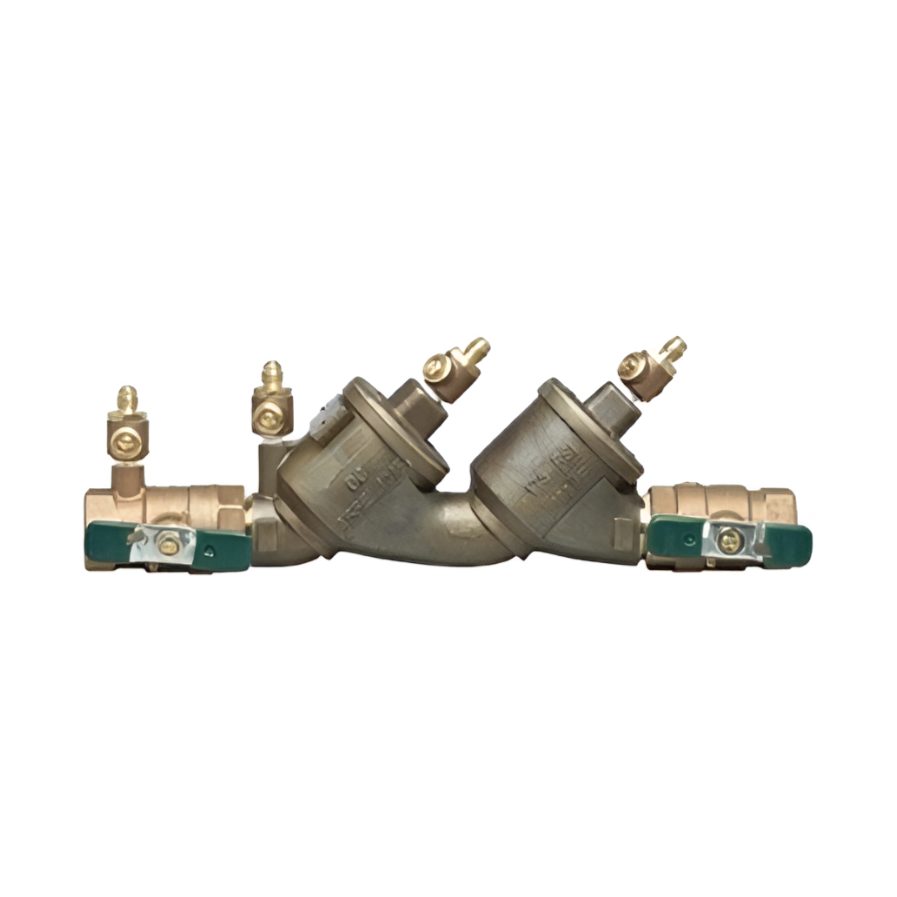
The Double Check Valve Assembly (DCVA) is, as its name suggests, a device designed to protect against backflow. It is used in continuous pressure applications that may be subject to back pressure or siphoning1. It is primarily found in interconnexions presenting a low health hazard; it is intended for low-or moderate-risks installations2.
COMPONENTS
The DCVA is equipped with two simple spring-loaded check valves assembled in a single body. It is fitted with four test cocks that allow for testing of the device and two shut-off valves2.
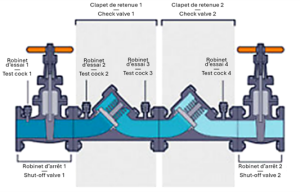
Source : https://www.rbq.gouv.qc.ca/fileadmin/medias/pdf/Publications/francais/guide-dar-protection-reseau-eau-potable.pdf, Figure 55 (traduite en anglais par Atelier Backflo Shop)
OPERATION
Under normal flow conditions, the check valves open with the supply pressure. They close if water flows back towards the supply to prevent any backflow3.
In the event of back pressure
Back pressure, i.e. backflow caused by a higher pressure at the device outlet than in the supply network, causes the second check valve to close, thus preventing any backflow. In case of leakage of the latter, the first check valve also closes3.
In the event of siphoning
When a siphoning occurs, the pressure at the inlet drops below the pressure downstream of the device. The first check valve then closes. If it is not perfectly sealed, the second check valve takes over and closes, thereby preventing any reversal of the flow direction3.
GENERAL INFORMATION
The DCVA must be inspected at the installation, in case of cleaning, repair or refurbishment, after a relocation, once a year and according to the instructions of the competent authority2.
This device can be installed horizontally or vertically, subject to approval by a recognized agency. In compliance with the standards requirements CSA B64.10, it can be installed below ground level, in a pit or vault, provided that the valves are properly sealed4.
The following moderate-risk devices are given as exemples2:
- Hairdressing sink
- Steam cleaner
- Chemical-free irrigation or heating system
- Soaking machine
STANDARDS
This device must comply with the Quebec Construction Code, as well as with standards CSA B64.5 and ASSE 10155.
In summary, the DCVA consists of two normally spring-loaded check valves installed between two shut-off valves and equipped with test cocks. In the event of backflow, the check valves close tightly, preventing any contamination of the water supply. The DCVA is designed to operate under continuous pressure and must be tested annually. It is suitable for protection against low or moderate risks. If a high risk is present, a reduced pressure principle backflow preventer assembly (RP) is required to ensure the necessary level of protection.
Written by Aljydah Nouar
References:
- https://fr.watts.ca/products/plumbing-flow-control-solutions/backflow-preventers/double-check-valve-assemblies
- https://www.rbq.gouv.qc.ca/fileadmin/medias/pdf/Publications/francais/guide-dar-protection-reseau-eau-potable.pdf
- https://www.smartwaterbackflow.com/double-check-valve-assembly.php
- https://backflow-shop.com/produit/dispositifs-antirefoulement-a-deux-clapets-de-retenue-et-robinets-dessai-dar2cr/
- https://nrc-publications.canada.ca/fra/voir/td/?id=3ef82391-8a8a-4dfc-848f-bea6301bafb5