
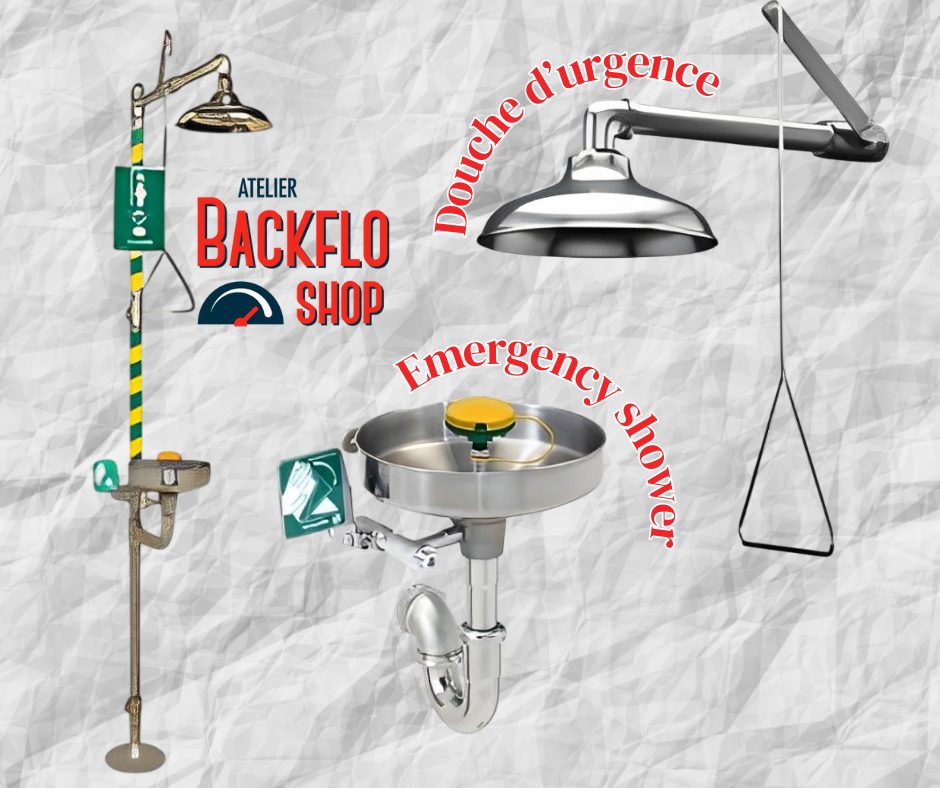
Is your emergency shower up to standard?
A 2022 study revealed that 88% of North American emergency showers are non-compliant. This demonstrates that these equipments are often neglected.[1]
Possible causes of this negligence?
- Lack of budget,
- Lack of resources,
- Lack of time,
- Lack of knowledge (ignorance).
Importance
Emergency showers are mandatory, or at least highly recommended, in high-risk workplaces. They help mitigate the effects of an incident and protect workers’ health while awaiting the arrival of first responders.
How it works
The first 10 to 15 seconds following exposure to a hazardous substance are crucial. It is therefore important to act quickly.[2]
The American standard ANSI Z-358.1 (2014) serves as a reference in Canada for emergency shower compliance specifications; however, its numerous technical requirements are often unknown or incorrectly implemented.
The water must be:
- Clean,
- At the right temperature,
- In sufficient quantity,
- Applied for 15-20 minutes.
In addition to these basic functions, several other essential parameters must be considered to ensure the true effectiveness of an emergency shower.
Accessibility
Employees must be able to reach it in less than 10 seconds, and it must be located within 17 meters, along a straight and unobstructed path. The shower must be also easy to use (properly adjusted jets) and easy to activate.
Maintenance and Inspection:
Weekly maintenance is required to prevent stagnant water and to check for cleanliness and temperature. In addition, a complete annual inspection must be scheduled to ensure safe operation.
User Training
Emergency showers, required by health and safety organizations, rely on the collaboration of engineers, Occupational Health & Safety managers, and maintenance staff, but it is the employees who will use them in the event of an accident. Employees must be trained on the function of the emergency showers in place and the safety protocol if needed.
Conclusion
Emergency showers are essential equipment for protecting the health and safety of workers. Investing in their compliance not only meets regulatory requirements, but more importantly, ensures optimal protection for workers and reduces the severity of incidents.
Article written by: Abbie Chagnon